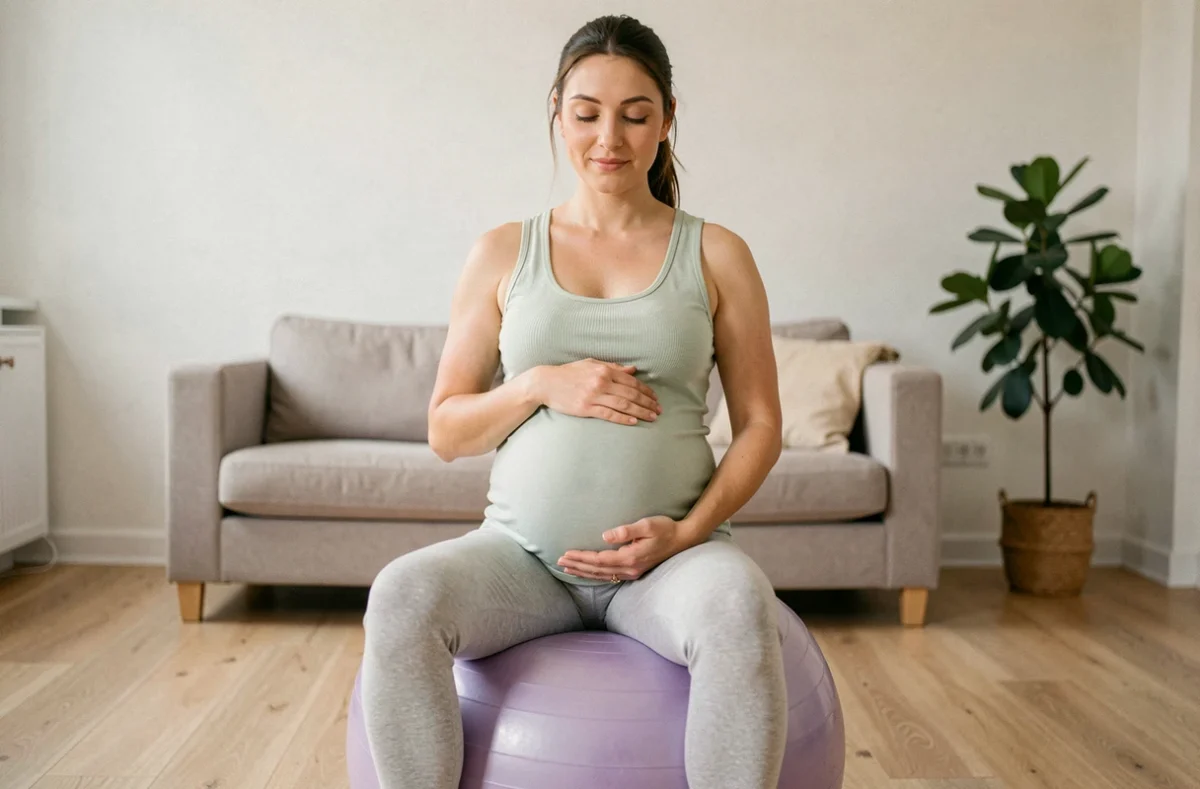
For a woman who is 1m57 tall, the 55 cm diameter ball is the reference size. Manufacturers’ sizing charts agree on this point: below 1m55, the 55 cm is the clear choice. Between 1m55 and 1m65, the gray area begins, and it is precisely within this range that the morphology we are interested in lies.
Leg length and morphological ratio: the criterion that size charts ignore
The size/diameter grids published by most brands are based on standing height. This approach poses a technical problem: two women who are 1m57 can have very different femur lengths. However, on a ball, it is the distance from the ground to the hip crease that determines whether the posture is correct.
A woman who is 1m57 with a long torso and short legs will have her knees well above her hips on a 65 cm ball. Conversely, if her legs are proportionally long, a 55 cm ball may place her too low, with knees raised and pelvis in retroversion.
To clear up any doubts, the most reliable method is to test both diameters in their actual inflation configuration, or to rely on the postural test described below to choose the size of her birthing ball.
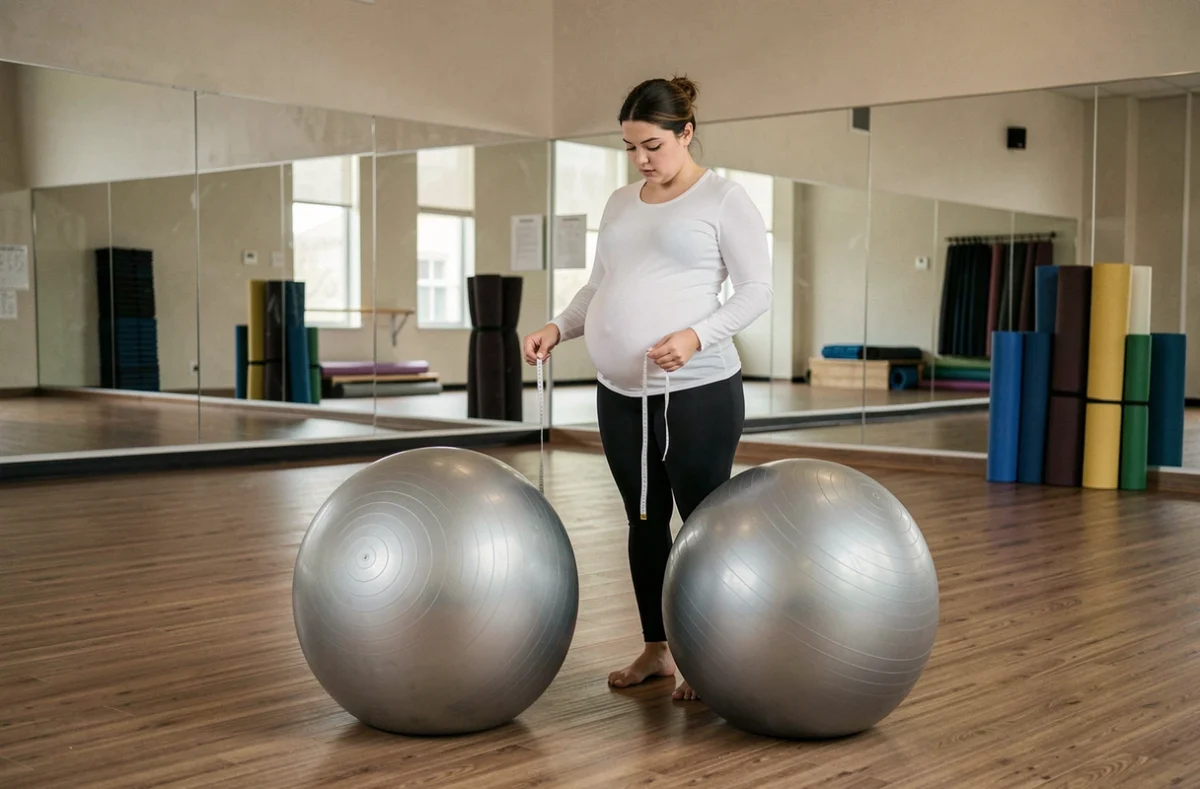
Postural test of the birthing ball: the 90-degree angle rule
The postural criterion is more reliable than a size chart. The verification is done sitting on the inflated ball, feet flat on the ground, spaced at hip width.
- The knees should be at hip height or slightly below, forming an angle of about 90 degrees at the knee joint.
- The feet remain fully on the ground, without the toes needing to compensate for a forward imbalance.
- If the knees rise significantly above the hips, the ball is too small or over-inflated. If the feet struggle to touch the ground, it is too large or too firm.
For a woman who is 1m57, this verification is particularly useful because she is at the boundary between two sizes. A 55 cm ball fully inflated may measure slightly more than its nominal diameter, while a slightly deflated 65 cm ball may drop below 60 cm in effective height.
Inflation pressure of the Swiss ball: the underestimated variable for smaller morphologies
The diameter indicated on the packaging corresponds to the ball inflated to its maximum capacity. In practice, the actual height depends heavily on the inflation and morphology of the user. A 65 cm ball inflated to 80% of its capacity can provide a seating experience comparable to a well-firm 55 cm ball.
This is a fact that consumer guides rarely mention. For a woman who is 1m57, an under-inflated 65 cm ball may technically work, but with two caveats.
The first concerns stability. A soft ball compresses more under body weight, which increases the contact surface with the ground and reduces proprioceptive instability. For pelvic mobilizations during labor, this reduced instability is not necessarily a drawback. For muscle strengthening or balance work, it limits the effectiveness of the exercise.
The second concerns durability. If you plan to use the ball beyond pregnancy, it is better to start with the diameter suited to your morphology rather than maintaining a 65 cm in permanent under-inflation.
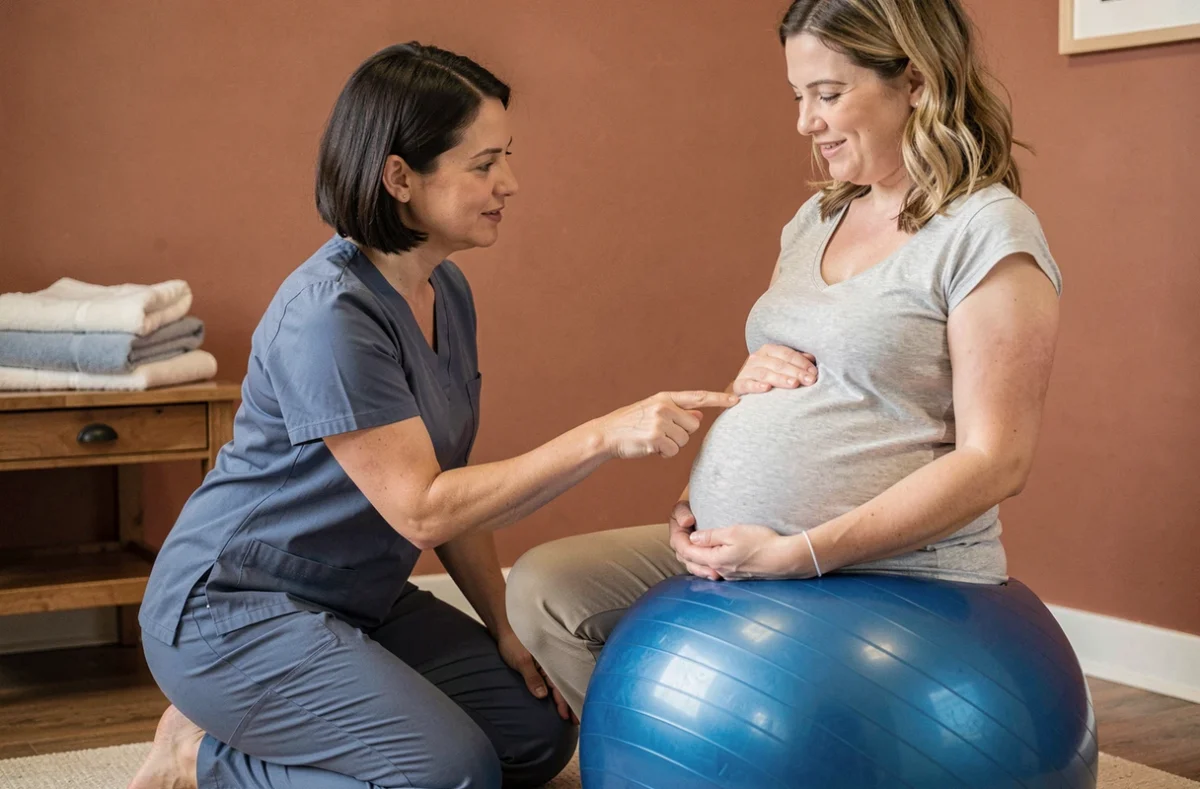
55 cm or 65 cm ball for a woman who is 1m57: deciding based on the intended use
The ideal size can change depending on the use. We observe three distinct scenarios for this height.
For primarily seated use (office work, gentle pelvic mobilization at the end of pregnancy, waiting positions during labor), the 55 cm offers the best seating without compromising inflation. The feet remain stable, the pelvis maintains its natural anteversion, and circular or rocking movements are made without compensatory effort in the ankles.
For floor strengthening exercises (glute bridge, front plank, adductors), the diameter matters less since the ball serves as support rather than a seat. A 65 cm may then be suitable, and it will be reusable in the postpartum period for other exercises where seating height is no longer the main criterion.
For the delivery room, the choice also depends on the equipment available on-site. Most maternity wards offer 65 cm balls. If you bring your own, a properly inflated 55 cm will be more suitable for your morphology than a standard delivery room ball.
Body weight and maximum load
The user’s weight also comes into play, not for choosing the diameter, but for the ball’s resistance. Anti-burst models generally support several hundred kilos. Check for the “anti-burst” or “ABS” (Anti-Burst System) label on the product, especially towards the end of pregnancy when pressure on the ball is more frequent and prolonged.
For a woman who is 1m57, the 55 cm remains the safest choice initially. The only valid reason to switch to the 65 cm is an unusually long leg length for this height, verifiable by the postural test described above. Everything else, including the argument of the “universal ball,” is a simplification that does not take into account morphologies below 1m60.