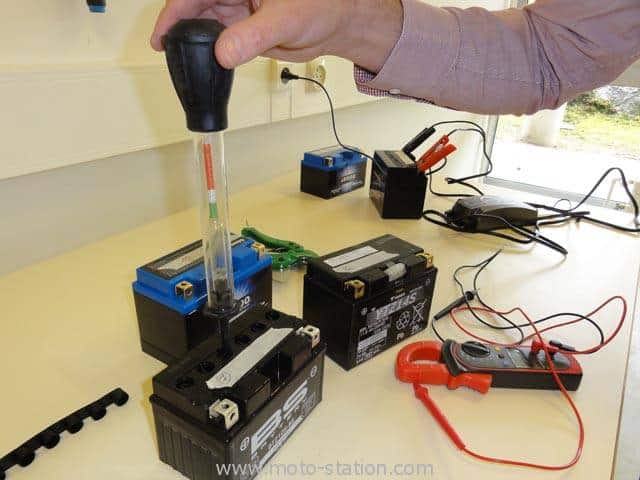
The cold is (re) knocking at the door… and it’s draining the batteries of our motorcycles and scooters. A little technical reminder that might save you the trouble… next time.
Various phenomena greatly influence the starting of the motorcycle during winter and/or after a long period of inactivity. First and foremost, of course, the battery capacity. It should be noted that these decrease proportionally to the outside temperature. It is generally estimated that below an ambient temperature of 20°, the battery power would decrease by 1% for every 2° drop. In other words, at 0° this loss would be 10%, at -10° it would be 15%, and so on. Additionally, there is of course the loss of battery charge in case of prolonged inactivity, which varies depending on the type of battery: traditional lead, maintenance-free, dry, gel, lithium, etc. A conventional battery would lose 50% of its charge after 3 to 5 months.
Battery operation and charging
Mechanical constraints, including the viscosity of the oil which increases with lower temperatures, thus requiring more energy to drive the engine when it’s cold. It is also necessary to account for the consumption of various motorcycle equipment. For this, there are also . In particular, in recent years, the headlight ignition has become mandatory, so it can no longer be turned off (due to the absence of a switch on the handlebar) to preserve maximum energy for the starter. The same goes for the operation of fuel pumps or even the heating of carburetors via resistors, which also consume part of the necessary energy.
It is therefore easy to understand that the slightest failure of a battery and/or charging circuit often condemns you to leave on foot. That’s why it is necessary to take care of your battery (and your motorcycle, of course). In case you use your bike every day and in all weather (kudos!), you will probably never face a truly immobilizing battery failure, as it is constantly charged by its electrical circuit. On the other hand, if you use your bike occasionally and/or seasonally, and the upcoming sunny days have awakened your biker soul, the following will greatly help you to get interested.
Motorcycle battery maintenance: Station tips
Disconnect the battery to store it in a dry and temperate place. Otherwise, it’s safe to bet that at best your battery will be completely discharged but still recoverable, at worst… it will be sent directly to recycling. First of all, it is necessary to check its charge. Those who have read the article “It’s winter, successfully winterizing your motorcycle” have already .
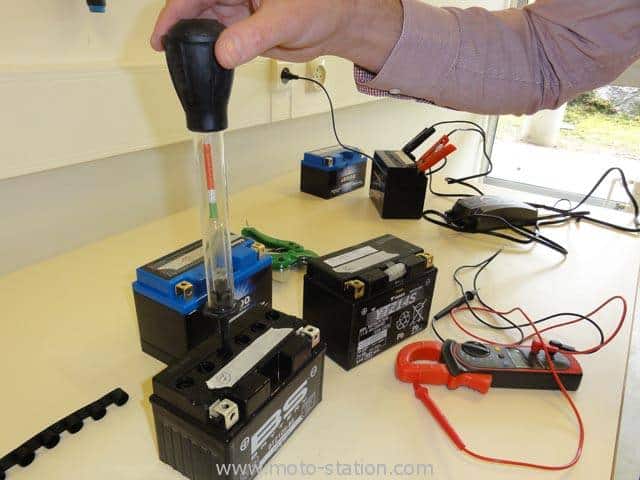
Test a classic motorcycle battery: The more equipped among you sometimes have a acid scale, a device that allows you to check each cell of the battery. To do this, you need to remove each cap, immerse the acid scale in… the acid, pump the liquid, and then observe the information provided.
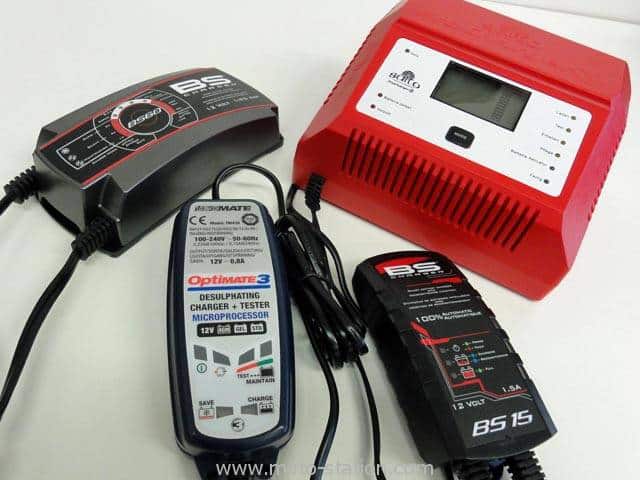
If one of the cells is defective (red graduation on the acid scale), then the battery is dead (short-circuited cell). If necessary, top up the cells with distilled water. If the battery can still function, charge it. In this case, be careful with car chargers that may be too powerful. Prefer a slow charge model for a motorcycle a multimeter will do the job, which will be able to deliver a current 10 times lower than the battery capacity (for example: a 11.2 Ah battery will be charged at 1.12 A). In the case — very likely — where you do not have an acid scale, see below.
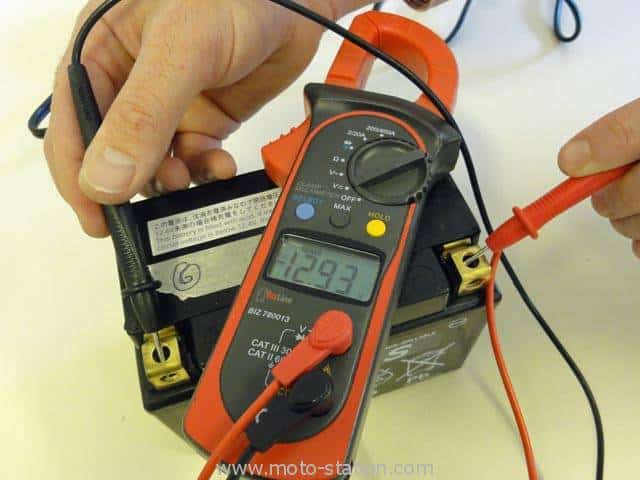
Testing a motorcycle battery with a multimeter
Test a maintenance-free motorcycle battery:
Check the voltage with a multimeter (selecting the DC current position). If the measured voltage is between 12.6 and 13 V, the battery is fully charged and ready for use. Between 12 and 12.5 V, a charge is required (same precautions as above, with a current 10 times lower than the battery’s charge capacity). Finally, a measured voltage below 10.3 V indicates a dead battery that will be impossible to charge (do not throw it away, but take it for recycling). Be careful, a battery that has a voltage above 13 V at its terminals is overcharged, most often short-circuited, rest in peace.
What charger for your motorcycle battery? Read our practical guide here
In brief
Our tips for starting your bike after a long period of inactivity (especially winterizing):
— Store your bike dry: moisture is not your best friend, especially if it freezes.
— Remove the battery and store it in a dry place at room temperature.
— Always charge the battery before putting it back after a long period. Otherwise, it sulfates quickly and will be irreparably condemned…
— Regularly monitor the charge of the removed battery (at least every two months).
— Check the charge of the battery before reinstalling it on the bike and recharge if necessary.
— Restarting a motorcycle after a long period of inactivity without having removed, checked, and/or charged the battery is generally doomed to failure. In this case, do not insist: the less the battery is discharged, the more you will be able to “recover” it with an adequate charger (if it is not sulfated).
— Never restart a motorcycle with jumper cables (that is, by connecting it to another battery) after completely draining its battery. Because in this case, once the motorcycle is restarted, its alternator charges a current that is too high which will again abruptly damage the battery (it is necessary to prefer long charges for deeply discharged batteries).
A big thank you to Bernard Taulou, professor of electrical engineering at the Lycée Maryse Bastié in Limoges, for his hospitality and advice.
Tag: recharge a scooter battery